Not because of a technical failure. Not because the bank did anything wrong. But because of a regulatory decision made hundreds of miles away.
The team can switch to another model. But the outputs are different. Validation work has to be repeated. Governance approvals need revisiting. Deadlines slip. Costs rise.
What failed wasn't the technology. It was the assumption that access would always be there.
This isn't a hypothetical scenario. Variations of it are already playing out across financial institutions, government agencies and industrial enterprises around the world. Yet when organizations choose an AI provider, they rarely ask a simple question: who ultimately controls the intelligence their business is becoming dependent on?
The map is already broken
The assumption built into most enterprise AI strategies is that access is a solved problem. You pick a model, you connect an API, you build your workflows. But access is not a strategy. It is just having pieces on the board in a game where someone else decides when they get taken off.
Other leading AI models are already unavailable in countries such as Russia, China, North Korea and Iran, not because of technical limitations, but because of export controls, sanctions regimes and regulatory restrictions. In other words, AI is not available unconditionally and access is always mediated by the jurisdiction of the vendor, the regulations of the host country, and the geopolitical relationship between them. For the enterprises, governments, and citizens inside those borders, the most capable AI tools in the world are not available. They simply do not exist.
The reverse is equally instructive. The leading Chinese-built Large Language Model that briefly commanded global attention for its performance, was welcomed, then rapidly banned or blocked across the U.S., EU, South Korea, Australia, and India, in some cases within days of institutional adoption. Defense departments, government agencies, and enterprises were told to remove it from their systems. A model that had been publicly celebrated as a neutral, open-weight alternative became geopolitically radioactive almost overnight. The lesson was stark: there is no neutral AI because every model carries the jurisdiction of its origin.
In 2023, Italy's data protection authority, the Garante, suspended access to the country’s most widely used AI system over GDPR compliance concerns. It was reinstained, but not before an entire national market lost access to the AI tool without warning, without a migration path, and without any input from the organizations that had come to depend on it.
And beneath all of this sits a harder problem: compute. U.S. export controls on the most advanced AI chips—the NVIDIA H100s and A100s that underpin frontier model training and inference—have created a structural ceiling for entire countries. Nations that cannot source this hardware face a fundamental limitation on what AI they can build, run, or control. Sovereignty at the model layer is meaningless if you don't own the compute layer underneath it.
China has responded by building a walled AI ecosystem where foreign models cannot legally operate without government approval and domestic data residency compliance. In effect, the world's most populous market has decoupled from the global AI stack entirely. Saudi Arabia and the Gulf states are moving in the same direction by requiring AI infrastructure to be hosted domestically as a matter of national policy, not preference.




This is not a compliance problem
When faced with any of the examples above, the first instinct is to route the issue to the legal or compliance team. GDPR, export controls and data residency requirements all sound like regulatory matters. That instinct misses the real issue.
What we're describing is not a compliance problem. It's a dependency problem.
The risk isn't simply that access disappears. It's that critical business capabilities become dependent on models, infrastructure and providers outside your control.
A CFO would never build the treasury function around a supplier that could unilaterally change pricing, functionality or availability. Yet many organizations are doing exactly that with AI. If a change in a vendor's policy, commercial terms or regulatory environment would materially disrupt your operations, you don't own that capability. You depend on it.
The sovereignty illusion
Many enterprises believe they have already addressed this concern. They point to private cloud deployments, data residency agreements and fine-tuned models as evidence that they have achieved a meaningful form of AI sovereignty. These are important steps, but they do not fully address the underlying dependency.
Private deployment of a third-party model is not ownership. The model, its evolution and its future remain under the vendor's control. If terms change, models are deprecated or access is restricted, your organisation adapts.
Data residency and fine-tuning reduce risk, but they do not fundamentally change the relationship. The intelligence layer your operations depend on still belongs to someone else.
Real sovereignty is not about where AI runs. It is about who owns, governs and controls the intelligence itself.

What ownership actually means
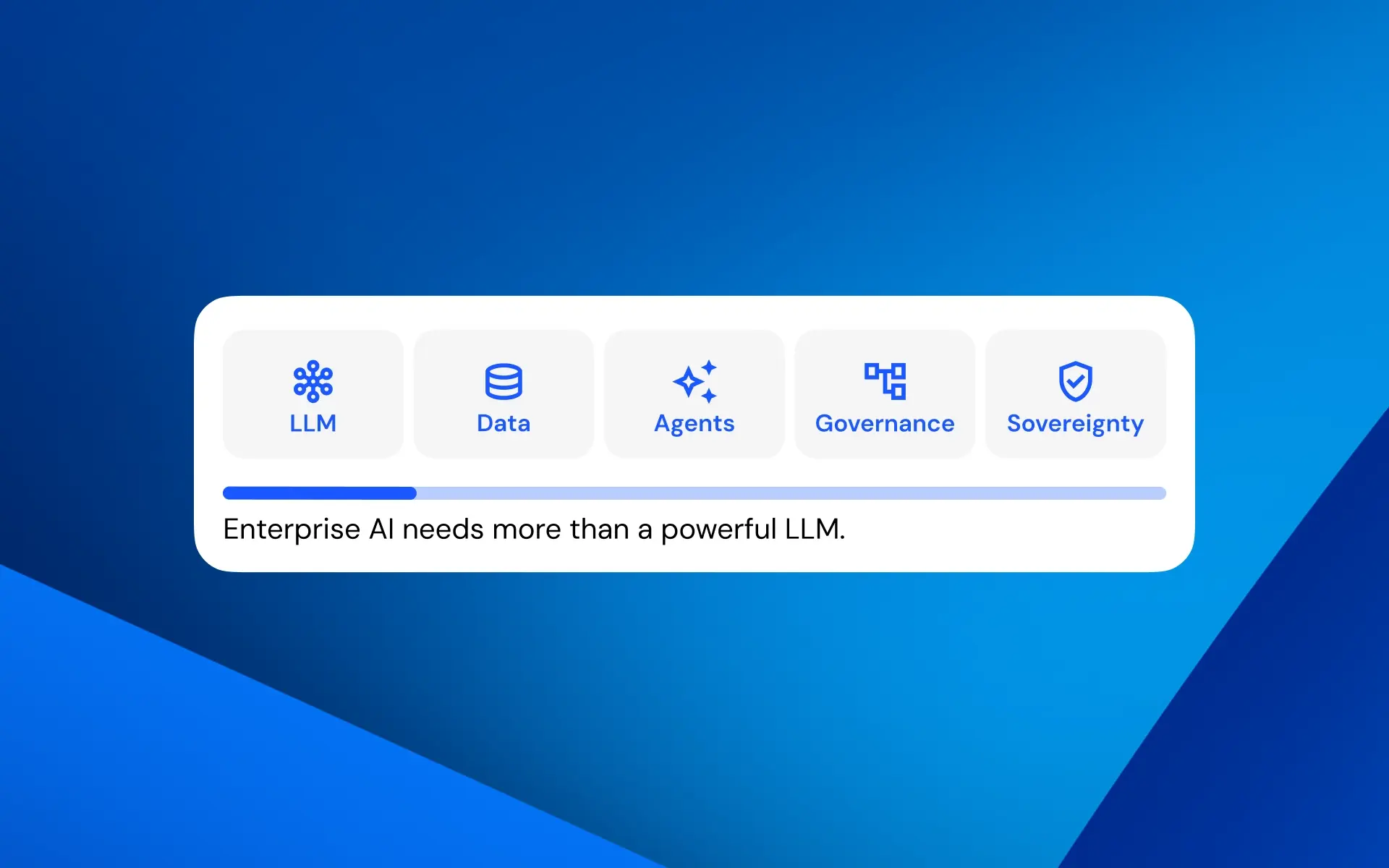
For regulated industries — financial services, government, defense, healthcare, critical manufacturing — AI sovereignty isn’t achieved through a contractual arrangement or a cloud configuration. Instead, it means owning the full stack: the models, the data layer, the governance mechanisms, and the compute.
It starts with proprietary models trained on your domain data, so the intelligence your organisation develops compounds over time and belongs to you, not the vendor who provided the base model.
It includes a knowledge layer that transforms fragmented data into structured, queryable intelligence that becomes more valuable over time.
It means governance built into the intelligence layer itself, resulting in AI that can be explained, audited and controlled in production.
And it requires compute independence: infrastructure that remains available regardless of changes in vendor policy, regulation or geopolitics.
For regulated industries, these are not edge cases. They are operating requirements. Sovereign AI infrastructure is not a competitive advantage. Increasingly, it is a prerequisite.
The window is narrowing
Every government is writing its own AI rules, on its own timeline, with its own enforcement structure. The lines being drawn between compliant and non-compliant, accessible and restricted, yours and someone else's are hardening fast. Every quarter spent building deeper dependency on third-party infrastructure is a quarter spent on the wrong side of them.
The enterprises that will lead in five years are not the ones with the best API integrations. They are the ones that understood, early enough, that intelligence is an asset — something to be owned, governed, and compounded — not a service to be subscribed to.
The border your AI cannot cross may not be a national one. It may be a vendor's terms of service, a sanctions update, or a regulator's morning decision. The real question has never been whether your AI travels. It's whether your organization can continue to operate when it doesn't.
Frequently Asked Questions