
Behind it all sits one implicit belief: intelligence scales with compute. Make the model large enough, train it long enough, and it will eventually do everything we need it to do. That progress is far from over. Frontier models will continue to become more capable and remain a critical foundation for the next generation of AI. But one assumption deserves closer examination: whether increasing model scale alone will be enough to unlock the full value of intelligence.
For a while, the evidence supported this. The returns were real and the progress was fast. But something was still missing, and the cracks have quietly been spreading. The question worth asking now — while the investment is still flowing and the consensus still holds — is not whether frontier models will continue to advance, but what else is required to turn that capability into durable, real-world value.
What LLMs brought to the AI revolution
To understand what comes next, it’s important to establish what LLMs have already made possible.
Large Language Models (LLMs) powered the generative AI wave as we know it, unlocking content creation at scale, task automation, and information retrieval without the friction of search. For knowledge workers, developers and anyone who works with language and information, the productivity gains are significant.
But the achievements of LLMs marked the first wave of AI, not the final destination. Frontier models are extraordinary achievements that matter enormously. They are undoubtedly powerful models that created their own revolution. But as we step into a new phase of AI, it is worth asking ourselves if a powerful model alone is enough to create durable value for the organizations deploying it. And here, the answer is more complicated.
LLMs are, in a precise sense, the simplest piece of software we have ever built at scale. A vast compression of human knowledge — trained on more text than any person could read in a thousand lifetimes — combined with a remarkably powerful mechanism for connecting concepts and generating coherent outputs. That combination turns out to be extraordinarily useful, but incomplete.
Put it this way, the model is the foundation. What an organization builds on top of it — the data layer, the domain-specific context, the governance, the orchestration across systems and workflows — is where most of the enterprise value actually lives. Model access matters but it is not enough. This is why owning the AI stack will increasingly determine how far a company can go.
Why the industry is betting on a hidden assumption
The entire AI market is built on a belief that rarely gets stated out loud: intelligence scales with compute. Make the model bigger, train it longer, feed it more data — and it will eventually solve what smaller models can't. Every major lab is running some version of this experiment, with major investors backing it.
For several years, it was the right bet to make. Scaling delivered results that few predicted, and the empirical case for continuing was hard to argue with. That progress is still continuing, and larger, more capable models will remain central to the future of AI.
But the nature of the returns is becoming more complex Progress is now logarithmic: ten times the compute and data to produce a system twice as capable. For many applications, models are already good enough. The bottleneck is no longer the model itself — it is everything that surrounds it. More scaling alone will not solve an organization's problems if the foundational layers beneath and around the model remain unaddressed. The lower hanging fruit has moved. In a market where frontier model training now costs billions, how efficiently compute can be converted into useful intelligence will become increasingly important.
The transformer architecture — the engine behind every major LLM — is one of the most significant inventions in the history of computing, but it is also already showing its limits. Context windows have grown, fine-tuning has become more efficient, and while the cost per inference is falling, the volume of inference is rising faster. And still, certain classes of problems remain stubbornly out of reach: multi-step reasoning across disconnected knowledge, structured understanding of complex relationships, outputs that can be traced, explained, and defended. These are architectural problems — not engineering issues that can be solved with more compute alone.
The hidden assumption that scale is the only path reflects genuine uncertainty about what comes next, combined with enormous financial momentum behind what already exists. But the organizations building on that assumption without questioning it are exposed. When the next architectural shift comes, the advantage will belong to those who saw it early.




Looking beyond the model
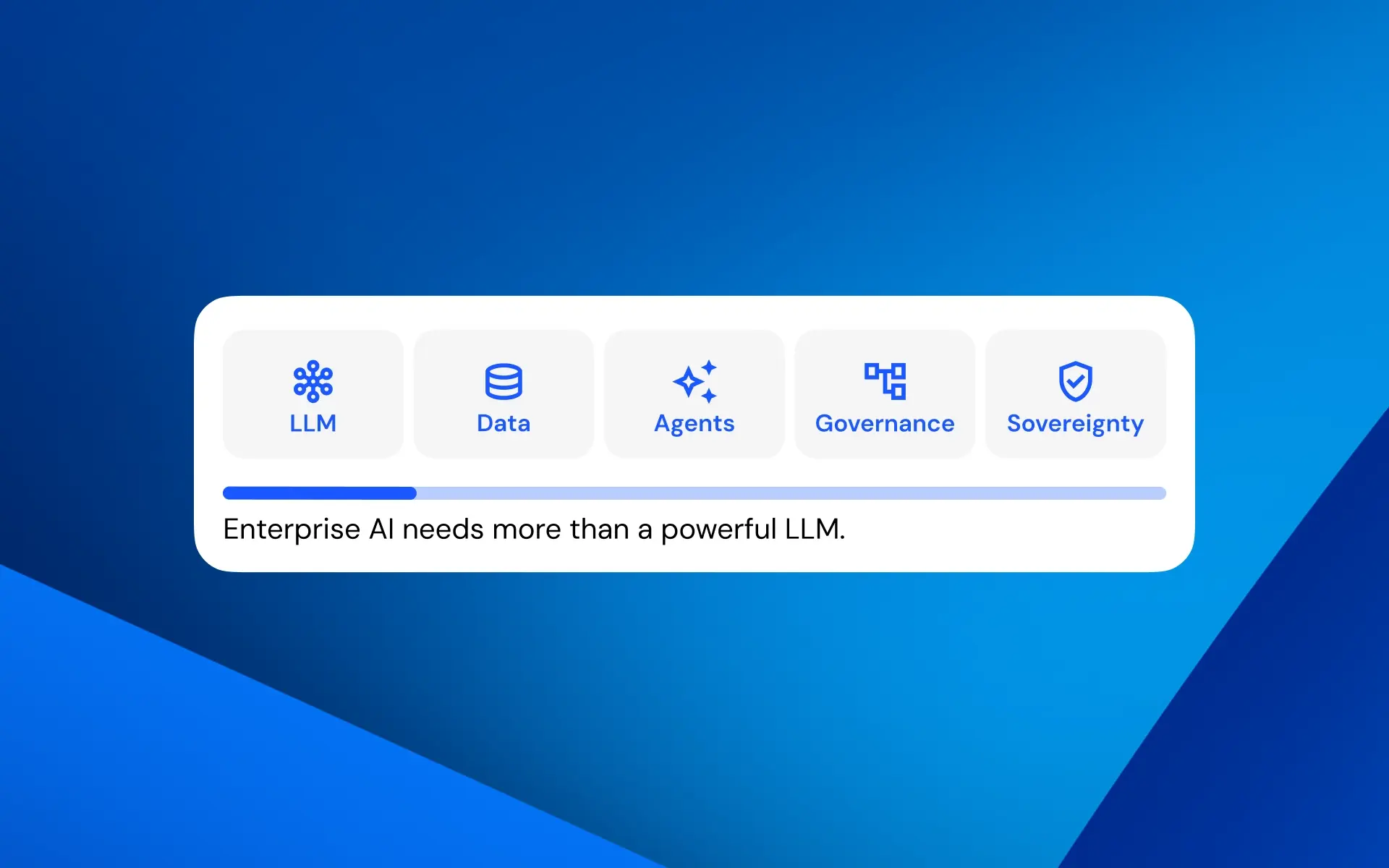
Enterprise value comes from what surrounds the model. The organizations that will win with AI will combine powerful models with agents, enterprise knowledge, orchestration and governance, tailored to their domain. The model is the foundation, but it is only one component of the enterprise AI stack.
Enterprise AI harnesses these elements together into a single intelligent operating system. It is this surrounding architecture, working with the model, rather than the model alone, that increasingly determines enterprise value.
We’ve been down that road before. The Big Data era promised that accumulating data would unlock competitive advantage. For most organizations, it didn't — not because the data wasn't valuable, but because the work of integrating systems around real business outcomes proved far harder than collecting the data in the first place. Companies built data lakes that became data swamps. The insights were there, but the architecture to act on them wasn't.
AI could potentially repeat this exact same pattern. Organizations are accumulating model capabilities the way they once accumulated data with insufficient clarity about what it takes to turn capability into outcomes. That gap between a powerful model and a functioning intelligent system is where most enterprise AI projects quietly fail.
To get it right, companies will have to integrate intelligence vertically into domain-specific workflows, so that the model, the data, the orchestration, and the governance work together as a coherent system rather than a collection of loosely connected parts. That kind of integration requires deep domain knowledge, strong data infrastructure, and a commitment to building for accountability as well as capability.
What the next architecture actually requires
More often than not, enterprise knowledge is fragmented across document repositories, CRMs, databases or institutional knowledge in email threads and meeting notes that were never designed to be queried at all.
LLMs in their current form were not built to solve this structural problem on their own. Given the right context, a language model can reason, plan, call tools, and revise its approach based on outcomes — and that is a remarkable capability. But there is a limit it cannot reason past: it can only work with what it is given. Enterprise knowledge does not arrive neatly in a context window. It spans entities and relationships across multiple systems, accumulated over time, structurally connected in ways that are never fully visible in any single prompt. Understanding how a change in one part of a system propagates through others requires a different kind of architecture underneath the model, not a better model alone.
The first wave of enterprise AI has been about productivity. The next wave is likely to extend beyond productivity into discovery. Rather than helping organizations work more efficiently with existing knowledge, AI will increasingly help uncover new relationships, hidden patterns and previously unseen insights. In practice, this means detecting a risk signal before it becomes visible to any analyst — not by querying a database, but by reasoning across counterparty exposures, market conditions, transaction patterns, and macroeconomic indicators simultaneously, in real time.

Why this matters most in regulated industries
For most technology waves, regulated industries are late adopters. The compliance burden is real, the risk tolerance is lower, and the pace of institutional change rarely matches the pace of technological change. AI is following a similar pattern but with a twist that makes the stakes considerably higher.
For financial institutions, manufacturers, and governments, the question is not whether AI can produce useful outputs but whether those outputs can be traced, explained, and defended — to regulators, to auditors, to boards, and to the public. A system that produces the right answer for reasons it cannot articulate is not a system a regulated organization can safely deploy at scale. This imposes a set of requirements on the next architecture that go beyond capability:
- Traceability: the ability to show not just what the system concluded, but how it got there.
- Governance: the ability to control what the system knows, what it can access, and how its outputs are used.
- Sovereignty: the ability to own the intelligence, not just rent it. Once AI has demonstrated value, the next question is how an organization can depend on it without creating unacceptable technological or institutional knowledge dependency. Sovereignty reduces that risk by keeping proprietary data, institutional knowledge and critical AI capabilities within the organization’s control, rather than subject to an external provider’s infrastructure, policies or commercial decisions.
These are not constraints that conflict with building powerful AI systems. They are design requirements that point toward a more mature architecture, built for both accountability and capability, ownership and scale.
Organizations in regulated environments cannot afford intelligence they don't understand. But if they get this right, they also stand to gain the most. The combination of deep domain knowledge, rich proprietary data, and the governance infrastructure to deploy AI responsibly is a significant advantage, one that organizations built for compliance are, perhaps unexpectedly, well positioned to hold.
Conclusion
Five years into the generative AI wave, it is worth pausing to ask what we have actually built. LLMs are the clearest evidence yet that AI can work at scale, that it can be useful across an extraordinary range of tasks, and that the economic and scientific potential of machine intelligence is real. But they are also the foundation for what comes next — and the first wave of any technology revolution earns its place in history simply by proving that the revolution is possible.
Moving forward, progress will come not from scaling models alone, but from building a broader architecture around them,focused on sovereignty and ownership. For regulated industries, this brings the ambition of AI within reach, as it means intelligence can be deployed in ways they can trace, govern, and defend. That work might be more challenging than deploying an API but it is also where the durable advantage lives.
The architectures that will matter most have not yet become consensus — which means the window to build them, and to build them well, is open.
That is the revolution worth building towards.
Frequently Asked Questions