For many, renting AI feels like the safe choice. Sign up, plug in an API key, and within days teams can start drafting faster, summarizing faster, researching faster and getting to answers more quickly. Without infrastructure to build or models to train, the convenience is easy to grasp, but at what cost?
The companies who opt for AI that isn’t theirs accept AI that runs on infrastructure they don't control, on architecture they can't inspect, under terms someone else can change without notice. That was a manageable trade-off when AI was mainly used as a productivity tool to complete tasks such as email writing or document summarization. However, when AI sits inside decisioning, compliance, and customer-facing workflows the business depends on, the trade-off is unforgiving.
The more central AI becomes to how a company operates, the more expensive it becomes not to own it. This is the shift that separates enterprises that used AI early from enterprises that are actually built on it: the difference between using AI and owning it. Put simply, access lets you use intelligence. Ownership gives you the keys to it.
What "renting" AI actually costs you
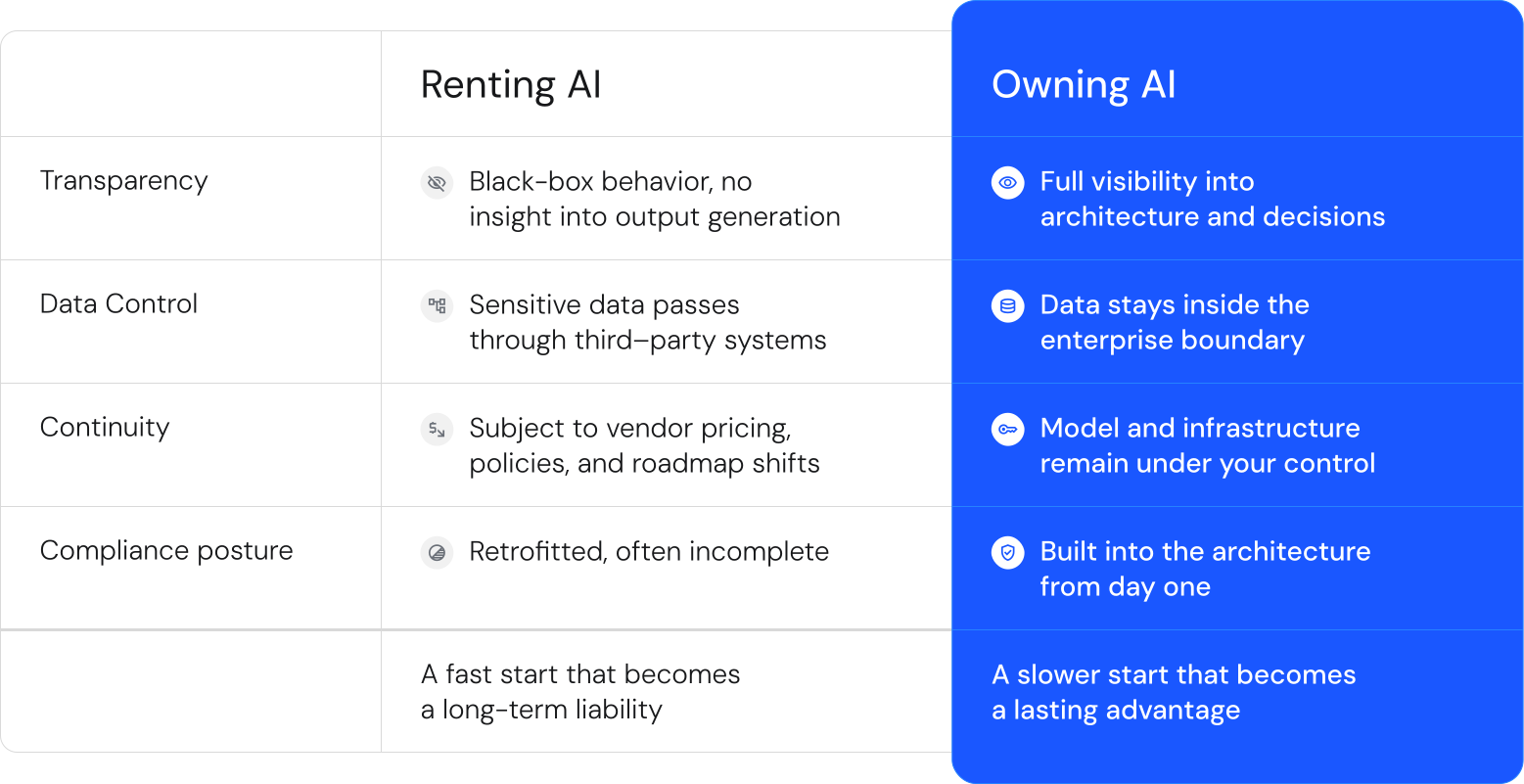
Rented AI refers to any system your enterprise accesses but doesn't control. A vendor-hosted, closed-architecture model reached through an API. You control the prompt, but not what’s underneath it.
That arrangement carries four distinct costs, each sitting in a different layer of the system:
- A lack of architectural control: A closed system can technically be configured to reflect your compliance rules, your domain language, or your risk logic, but only by working within the vendor's infrastructure. With a rented model, the architecture is fixed. You can prompt-engineer, fine-tune within guardrails, or wrap it in tooling — but you cannot rewire the model's internals, swap the tokenizer, or enforce custom retention logic at the weights level. The vendor decides what knobs exist; you only get to turn the ones they expose.
- Data exposure by design: Every prompt, document, or record sent through a third-party model passes through infrastructure you don't fully see. You're relying on a vendor's privacy policy — one that can change without notice and cannot be verified independently — to guarantee the full confidentiality that sensitive material requires, risking breach disclosures or exposed secrets.
- Roadmap dependency: Renting means accepting that your product roadmap becomes subordinate to whatever tech company is running your AI — pricing, capabilities, and deprecation timelines remain largely in the provider's hands.
- Vendor lock-in: Relying on a third-party model makes migration increasingly costly and complex. Some vendors let you fine-tune their model on your data and export what you've built, but that customization only works on their underlying model. You don't own the foundation, so you can't move your work elsewhere. Switch vendors and you lose the behavior you've trained, the optimizations you've learned, and the institutional knowledge baked into the system. You're rebuilding from scratch on a new foundation with different performance, different pricing, and different guardrails. The deeper you integrate with a rented model, the more your own roadmap ends up shaped by one you don't control
In short, while renting might be synonymous with a fast and convenient way to use AI, it is also a dependency that ultimately remains on someone else's terms. Every rented model carries an expiration date, even when the contract doesn't say so: a pricing change, a policy update, a newer model that replaces the one you built around. The foundation on which your business will grow to depend could change without your consent.
That does not mean every AI workload needs to be owned.If your ambition for AI stops at sporadic productivity tasks — drafting a memo or summarizing a report — the convenience of renting might be all you ever need. For many of these use cases, renting may be exactly the right answer. But the equation changes when AI starts touching proprietary knowledge, regulated decisions, or critical operations. At that point, access alone is no longer enough.



What AI ownership actually means
Owning AI means being handed the keys, not just access to the model.
Ownership isn't a compliance checkbox or a procurement preference. It's full sovereign control, accountability, and legal rights over an AI system and includes its design, its deployment, and its evolution over time.
And the keys are more than a copy of the model weights. They mean having the ability to run the AI, adapt it around your own knowledge and workflows, govern how it behaves, and continue developing it as your business changes.
That does not mean every enterprise needs to build a foundational model from scratch. The hard foundational work can already be done. What matters is that the organization then has the ownership and tools to shape that intelligence around its own business rather than remaining dependent on someone else's finished system.
In practice, ownership extends across the core assets that determine how the system operates and evolves:
- The codebase and algorithms that make the system run.
- The model architecture and weights — the actual intelligence, not just access to it.
- The datasets used to train and fine-tune the model.
- The outputs the model generates in production.
The organizations treating AI as a durable competitive advantage are the ones that hold all four. Miss even one, and the system is never fully in your possession, with dependency and lack of control still lurking somewhere beneath the surface.
Renting vs. owning, side by side
Why this matters most in regulated industries
In finance, healthcare, government, and other regulated sectors, an AI system is only as defensible as its ability to be explained and audited. Regulators don’t accept “the vendor's model said so” as an answer — and increasingly, neither do customers or boards.
For these industries, regulation demands traceability, human oversight, and explainability at every layer of an AI system — requirements that are structurally difficult to guarantee when the organization is using a black box it doesn't control. As such, ownership isn't a “nice-to-have” but the operational prerequisite to confidently explain how and why an AI system reached a given decision.
What full ownership actually looks like
At Domyn, AI ownership is an architecture you can point to, inspect, and stand behind. It is a full stack built from the ground up, not stitched together from vendor services:
- Proprietary models: Domyn Large and Domyn Small are built with full, permanent rights — not licensed through someone else's API, and not subject to someone else's usage terms.
- Governance built in, not bolted on: Auditability and oversight is embedded into every layer of the stack, so explainability isn't a report you generate after the fact — it's how the system runs.
- Owned intelligence, not borrowed context: The Knowledge Graph turns fragmented enterprise data into structured, reasoning-ready intelligence that belongs to you, not into disposable prompt context that evaporates after each session.
- Sovereign compute: Colosseum, Domyn's soon-to-come Supercomputer supports deployment on-premises, in a sovereign cloud, or fully air-gapped — wherever your data actually needs to live.
Crucially, none of it reports to an external vendor, as reasoning, state, and action stay inside your enterprise boundary forever.
Ownership is the next competitive line
AI's first wave was about access — who could get their hands on a capable model first. The second wave was about scale — who had the biggest model, the most compute. Both waves rewarded speed.
The next wave will reward those who actually own and govern the intelligence running their business. Speed may have gotten everyone into the AI race, but ownership will decide who's still standing at the end of it — and the brass ring will belong to whoever owns that intelligence outright, without qualification or condition.
Are you ready to claim that reward?

Frequently Asked Questions