

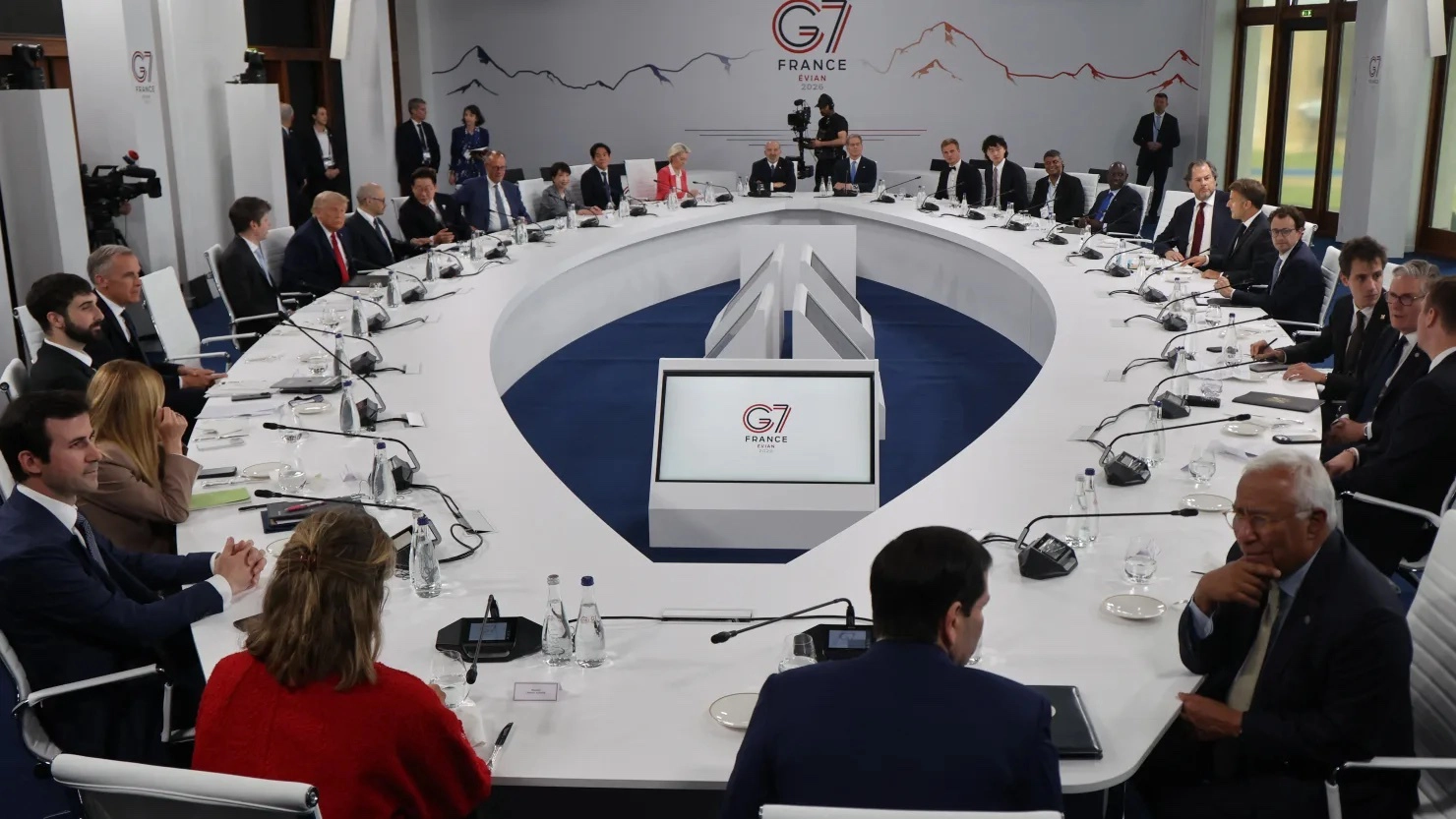
Over the past few weeks, I have had the opportunity to join discussions with political leaders, policymakers and fellow AI leaders on one of the defining questions of our time: how should we shape the next phase of artificial intelligence?
The discussions at the G7 were particularly revealing. While much of the conversation took place under Chatham House Rule, one thing became increasingly clear: the AI debate has entered a new phase.
For the past three years, the industry has measured progress through technical capability. Larger models, more compute, greater investment and increasingly impressive benchmarks have driven remarkable advances, and they will continue to do so.
But capability alone will not decide who leads the next phase of AI.
The biggest shift I saw at the G7 was not technological. It was economic and geopolitical. AI is no longer being discussed primarily as a technology issue. It’s increasingly being treated as an issue of industrial competitiveness, democratic resilience and national strategy. Another clear theme was the growing responsibility of the private sector. As AI becomes embedded across economies, ensuring greater transparency and accountability from the companies building these systems is becoming one of the defining challenges of the AI era.
That changes the questions we need to answer. The challenge is no longer simply building more capable models. It’s ensuring democratic societies can adopt AI with confidence, governments and enterprises can benefit from it without becoming strategically dependent, and the value it creates strengthens our economies and institutions rather than undermining them.
In other words, the debate has moved beyond technology. It’s now about how we build economies and societies that can succeed in the age of AI.
Capability remains the price of entry. But as AI becomes embedded in the critical infrastructure of our economies, trust will become the defining competitive advantage.
As AI moves from experimentation into critical business processes and public infrastructure, organizations need confidence that they understand the systems they depend on, that they can govern them appropriately and that they retain meaningful control over them. Without that confidence, adoption slows, regardless of how capable the underlying technology becomes.
That is why trust is becoming an economic advantage rather than simply a regulatory objective.
This is already becoming visible in sectors such as financial services, healthcare and government, where the challenge is no longer whether AI works. It’s whether organizations can trust it enough to deploy it across their most critical operations.
This also changes how we should think about sovereignty. Too often, sovereignty is reduced to where data is stored or where infrastructure is located. That definition is no longer sufficient.
As AI becomes strategic infrastructure, sovereignty becomes the ability to retain meaningful agency over the intelligence your organisation or economy increasingly depends upon. It’s about resilience, governance and ensuring that continued access to critical AI capabilities is not determined entirely by decisions outside your control.
This is not an argument for isolation. AI will continue to advance through international collaboration, shared research and open scientific progress. But collaboration is strongest when it exists between capable partners, each contributing something distinctive.
Europe should stop asking whether it arrived late to AI. It should start asking what role it wants to play in the next phase of AI. History shows that first movers create markets. Third movers redefine them. They make new technologies indispensable by making them trusted.
Apple did not invent the personal computer or the smartphone. It helped redefine both by making them accessible, intuitive and trusted by millions of people. The same principle applies to AI.
The United States continues to lead in frontier research and commercial scale. Asia is setting new standards in engineering efficiency. Europe should not try to replicate either. Its opportunity lies elsewhere. Europe has an opportunity to become AI's third mover, not by winning the first race, but by defining the conditions under which AI is trusted, adopted and deployed at scale.
Europe has spent decades building products the world trusts. People buy European cars because they trust their engineering. They buy European food because they trust its standards. They rely on European pharmaceuticals because they trust the science behind them. AI presents Europe with the opportunity to build that same reputation for intelligence.
Projects such as Europa suggest Europe is beginning to recognise something important: regulation alone will never create leadership. Capability must come first. Trust is built on capability, not instead of it.
Trust is not a European value. It’s becoming a global economic requirement. Every country, every enterprise and every citizen benefits if the systems underpinning the next generation of economic growth are transparent and governable.
I have often argued that AI is as much a social revolution as it’s a technological one. The discussions over recent weeks only reinforced that belief.
Every major technology ultimately succeeds because society chooses to depend on it. Electricity transformed industry because it became reliable. The internet transformed economies because people trusted it enough to bank, communicate and build businesses online.
AI is becoming a foundational layer of economic infrastructure. As that happens, trust will no longer be a desirable characteristic. It will become a prerequisite for adoption at scale.
Looking back on the discussions at the G7, what gives me optimism is not that we have all the answers. It is that we are finally asking the right questions. For heads of state, the invitation is to leverage the ground truths that are becoming increasingly clear. The assumptions that have shaped the AI debate are giving way to a new reality, where trust, resilience and strategic autonomy will increasingly determine how AI is adopted at scale.
Capability will always matter. But capability alone will not determine who leads the next phase of AI. The winners of the first AI race built the most capable systems. The winners of the next will be those that build the systems the world is prepared to depend upon.
They may not be the same winners.
Uljan Sharka


Frequently Asked Questions